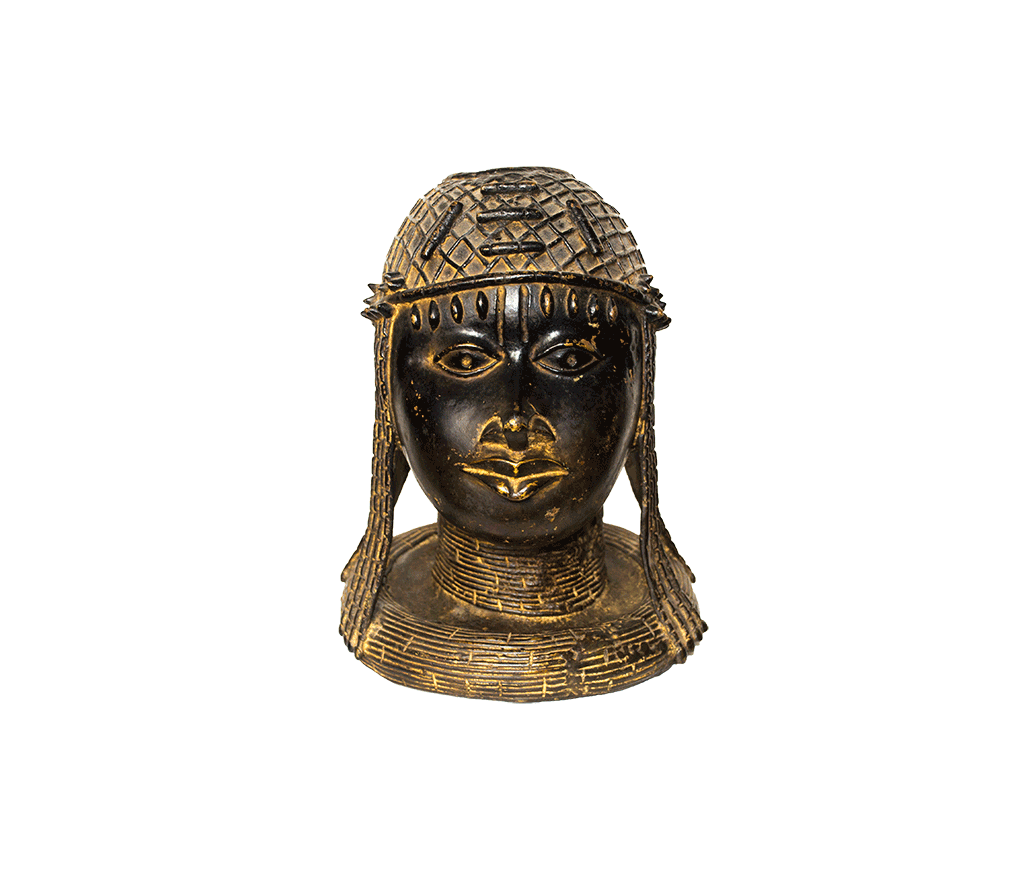
Nigeria, West Africa · Benin Kingdom
Benin Kingdom Woman
Piece #BR001 · Year Made: 1987
$4,999
Shipping individually quoted
Origin
Nigeria, West Africa
Period
Late 20th Century
Medium
Hand Carved Bronze
Length
9"
Width
9"
Height
11"
Details & Materials
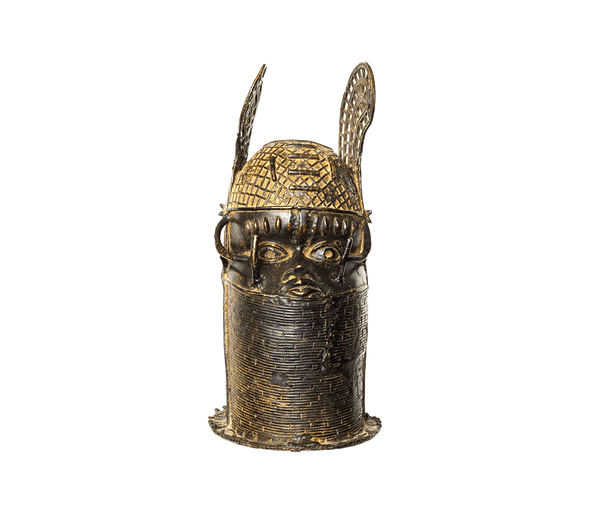
Benin’s royal altar heads appear in a range of styles from highly formalized to the more idealized naturalism of this example. Works such as this head, with its distinctive roll of coral bead work at the neck and beaded strands hanging from the crown, are believed to date to the 16th century. It is possible that the naturalistic elements of this head may reflect a connection with the brass-casting traditions of the Ife Kingdom to the northwest.
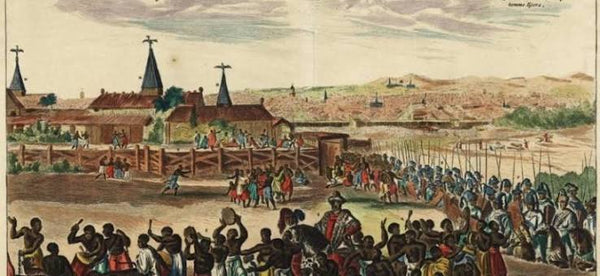
When you purchase this piece, you are purchasing a piece of history, namely the fascinating and majestic history of Benin City. A little-known fact is the world’s largest man-made structure was made in Nigeria. Its length was over 9,900 miles, about four times that of the Great Wall of China. The Wall of Benin was used for defense of the historical Benin City, now the capital of the present-day Edo State of (southern) Nigeria. The Benin Walls were ravaged by the British in 1897. Other accomplishments of the Benin Kingdom are their disciplined army, infrastructure, and of course, royal artworks.
More significantly, perhaps, is that art from Benin has come to represent the achievements of the Nigerian peoples to reaffirm links to the autonomy of a precolonial past.
This unique piece was hand made by the Benin peoples of Nigeria. No factories or machinery was involved in the production process, only artisans and hand tools with painstaking detail and precision. This piece is made out of natural materials and is free from any fillers, dyes, stains, or varnishes. There is ONLY ONE piece in existence--truly one of a kind.
- Condition: Excellent, not previously owned, undamaged
- Sourcing: Fair Trade
- Certificate of Authenticity: Available Upon Request
- Provenance Report: Available Upon Request
Shipping
Buy now and leave the shipping to us. At checkout you pay for the piece plus a shipping deposit. We then plan the packing for your piece and email you the remaining shipping balance. This applies to both domestic and international orders. Every shipment is tracked, and most deliveries need a signature.
- Domestic: 5-8 business days
- International: 10-14 business days
- White-glove delivery available on request
Care & Placement
Dust with a soft, dry cloth. Place the piece on a level surface. Lift it by the base rather than by a raised limb.
Origin
Nigeria
West Africa
"When I was first exposed to African art, I felt a deep connection to it. It is hard to explain. It resonates with me spiritually."
Michael, Founder
York's Shona Gallery was the first in New York City to bring African sculpture to American collectors. Every piece in our collection is acquired directly, ensuring authenticity and fair exchange with the artists and communities who create them.

About the Tribe

Benin Kingdom
Bronze Sculpture
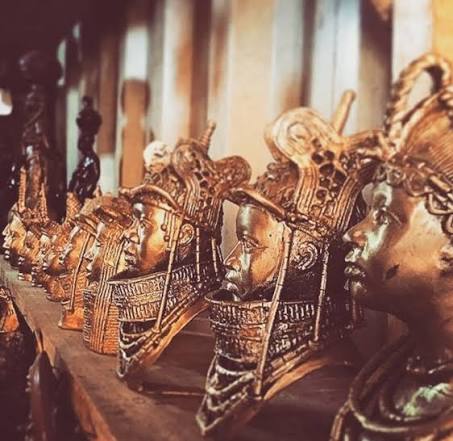
The vast array of castings in bronze and leaded brass taken from the palace of the Oba of Benin in 1897 have been dispersed throughout Europe, the United States, and elsewhere. The interest generated by these artworks, along with the ivory carvings and coral regalia, has been a major factor in the development of Benin studies. The sculpture from Benin has come to represent the achievements of the Edo Kingdom of Benin in museums around the world. Within Africa they have been utilized in the construction of national and pan-national identities to reaffirm links to the autonomy of a precolonial past.
In 1938, ground was being dug to construct a house in the Wunmonijie Compound, now immediately behind the palace in Ife, but formerly within the palace wall. The workers found two groups of castings. Most were of life-size heads, two were smaller than life size and wore crowns. In addition, there was the upper part of a figure that closely resembles that of a king (Ooni) found in 1957 at Ita Yemoo. Their portrait-like naturalism astounded the Western art world despite the fact that the German explorer and ethnographer Leo Frobenius had called attention to the artistry of these figures as early as 1910, when he discovered a crowned metal head and a score of terracotta sculptures. It was no more considered in 1938 than in 1910 that these could really be the work of African sculptors unless they had worked under a European master. Soon after World war II, William Fagg argued persuasively that these were indeed objects made by the Africans before Europeans first landed on the Guinea Coast.
In your home
Loading the room...